reflections on the cycling movement, photography, the environment, and food from a budding transport planner and a self described foodie and cycle commuter.
First off, the city website is a mess, but that is beside the point, at least the information is there. (unlike the city of Plattsburgh site...).
Second, the map is actually oriented North (amazing right!) which is good, but there is no legend included that would tell a viewer the difference between black and red markers. (Actually it turns out the red markers are the recently launched, Jan 18th, and the black were ones already operating during the fall, I decided not to differentiate between them, once I know more of the planned expansion locations I will add them differently. Of course you had to click on the faq to find that, and see the original map with legend(pg2), which had a Western orientation...)
Thirdly, there is very little information on the businesses or other orientating information, other than road names, you are unable to move around and get your bearing if you are not a resident, and that is really the key point.
Now these are actually relatively minor issues compared to some maps I have seen (the ward map, a complete mess until you zoom way in; my version of it can be found Here); the kiosks are close enough together and visible enough that finding one on the ground should not pose a problem though.
The point of the matter is though, that I created the above map using Google (Google Earth, and then uploaded to maps), it took about an hour to do it, including creating the custom marker icon, and now we have a map that is interactive, somebody can search for businesses, or figure out where they are, they can go into streetview and see what the area looks like (meters won't show up though, too recent) they can create trips and better plan for a visit to the city.
The map as the city created it is designed for residents (and even then it may be confusing). That is not a bad thing, but it could have easily been designed for anybody.
The city really needs to get its act in gear and start making use of Google maps and the huge potential that is being missed. The planning department uses Google maps to create maps of locations on their agenda for the next meeting, a very good and useful idea! I think the city as a whole though can, and must do better!
Communities need to stop thinking like it's 1980, data is all stand-alone, and if somebody wants something they will call or go down to city hall to get it. There are so many more opportunities for the city to really sell its presence and what’s happening; online. These are fairly simple to implement and would go a long way toward providing accessibility to city resources and services.
Simply providing city resource maps through Google would be an enormous step.
Some winter Dutch Envy for you, an older Video from Mark Wagenbuur over in the Netherlands on bicycle training for school children. He has a great deal of wonderful videos on his profile, I highly recommend you check out more from him. David Hembrow also posts latest videos and commentary on topics using the video's at his blog as well (which is where I got this).
This is how the Dutch do training for cyclists, focusing on the test before the start of high school or equivalent. Its pretty amazing to see how they do it, and what is required of the students taking the test.
When our driving tests are to "go out around the block and park" and you get your license, I am not sure we could actually ever do anything as rigorous as this anytime soon. I think we need to get our driving tests down to something a bit more challenging before we ever embark on something like this, however integrating traffic into the curriculum from an early age is certainly a very good idea
enjoy! (OMG where are the helmets, they could die, or fall over, or hurt themselves!!! ok I am done now ;) )
Came across this link from one of the blogs I frequently read on Google Reader. I warn you right off though; it’s a long article. (Update: yep it was from the Planetizen network, their link is Here)
Many in the New Urbanism movement know of JSK, many in the cycling and walking communities know of her, and certainly in NYC, they know of her work. She is an international superstar, and is very popular with livable streets and transportation equity folks (along with Mr. Transportation Secretary Ray LaHood)
So who is Janette Sadik-Khan, Esquire magazine (yes That Esquire) has a very good article looking at her in relation to another giant of NYC; Robert Moses.
The way she works to get around red tape and bring people on board, even if they were originally against her, can be a model for cities and DOT's nations wide. She has the facts to back up her claims, and to show naysayers that they really don't know what they are talking about, but without bluntly telling them off (as was Moses's style).
Her work is transforming NYC back to a future where people are king, not the car. She is the anti-Robert Moses and her timing couldn't have been better.
This post is just the prologue to a 4 part series on cycling in Montréal. I visit the city usually 2 to 3 times a year and have been doing so for the past 17+ years, and as such have sometimes taken the push for cycling, and separated infrastructure, for granted.
On the other hand, I simply may have not appreciated it, noticed it, or been unable to take pictures. Now with the opportunities that Bixi opens up, I am able to get a first hand picture of the bike share program, as well as the routes that make it safe for a less experienced cyclist, to get to many destinations in the city using a Bixi.
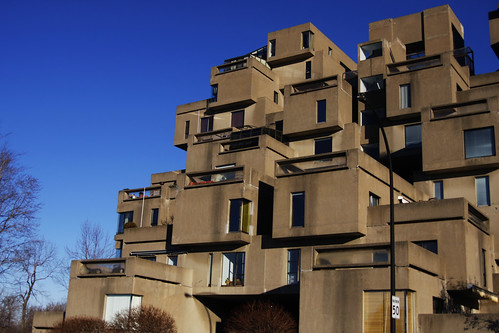
Part one will be some pictures and thoughts on a commuter cycling highway along the famous Habitat 67.
Part two will be some of the separated infrastructure of the city, from the eye of a Bixi.
Part three will be just on Bixi, from Fall 2009 and Fall 2010, what they seemed to have learned, and what improvements are perhaps needed, as well as impressions on use.
Finally part 4 will deal with bicycle parking in the city, and the variations of parking stalls that are used.
I will attempt to spread them out, and by breaking them up I hope to be able to post a little bit shorter posts on each one, and be able to go a bit more in-depth. I will plan to start posting part one later next week, and attempt to post one every week or so. However, finals are coming up, as well as my graduation, so there will most likely be a delay in part three and four at least.
I linked to the ecovelo teaser of this new bicycle from Breezer a bit ago, it was shown off at Interbike earlier this year. I always bring my Breezer into the newest bike shop in Plattsburgh, and the only dedicated shop, Mountain Riders. Talking with the owner and head grease monkey or the past months, and seeing my Breezer, talking with him about my (few) upgrades, talking quality of parts and such, he has decided to become a Breezer dealer. This will be a great fit, he was a dealer before out in Colorado, has owned a Breezer mountain bike for many years, and strongly believes in the company and quality of work.
That being said, in the next 1-2 weeks, the Infinities'(?) will be shipping out to first orders (from what I know), he has ordered one for the shop and I will be able to test ride it for him once it comes in.
Needless to say I am quite excited!!! I will post a review and thoughts when it comes in.
specs are now online at the Breezer site, Click Here for more information.
Rest assured I am still here and still working on the various projects I am pushing. My time is limited, and what I am not using in class or to push projects, is being used to keep up to date on the latest happenings in the transportation community, and looking for internships for early next year. I simply do not have the energy to keep up here while doing everything else, even if I actually do have the time.
I will post here every once in a bit, and I appreciate folks checking back in every once in awhile. If you do not yet follow me on some type of reader, Google or otherwise, I highly recommend that you do, that way you will know when I start posting again.
Bicycle racks have been ordered and shipped, Phase one is moving forward quickly. Meeting with facilities to determine final location prep next week, a couple sites have already been picked out for a ceremonial install, the next step is planning for that event and making it big.
On the death that happened the other week, prosecution seems limited, even though it was a hit and run and the driver ran a red light, he apparently did not see the cyclist. The cyclist was on the sidewalk through this intersection, no it is not illegal to be on the sidewalk in the town of Plattsburgh (that I know of). However, sidewalk riding is incredibly dangerous for all road users, and until we have proper bicycle roads along auto roads, it is still best to be in a lane. He was new here and did not know the area well, and it is hard to take a lane when you are surrounded by 6 lanes of traffic moving at high speed.
The bike group on campus is working to advocate for a bike lane for the road, I am working to have them change the goal to be increased bicycle safety on the road, not advocating for a specific infrastructure fix. There really is no easy fix for this road, a bike lane or a separate bike road(cycletrack, bike path etc) will make it worse, there are simply too many driveway cuts.
The Campus Facilities Master Plan comes out in November, and is in final stages now. I am involved with asking questions regarding bike and ped improvements for a couple of the planned streets through campus, they have not answered many questions, and there are potential problems with what they are advocating we create, especially if they are leaving it up to the planners here to figure out the specifics.
Finally on to the posted image, it is a map I created that marks all the designated public park space in the city of Plattsburgh, combined with a two different distance buffers showing accessibility and distribution of parks. Overall Plattsburgh is doing pretty darn well, with full accessibility for the entire city within about 1/2mile of a park. It is not a perfect map, there is no scale and while North is "up" it is not designated as such, anyway.
For now that is all, stay tuned, I will update when I can, Jim is busy as well but might try to get some posts in, he has some topics in the wings.
I just learned late yesterday of a death a bit west of campus due to a student riding a bicycle. I know little more than that right now, but with little to no infrastructure, and no respect from cars, it was inevitable somebody would die in this city, and it had happened before. Maybe some things will change now, to preserve his memory.
However I highly doubt it.
We can do better, we must do better, this is what fuels me to keep pushing against the odds.
Somebody dieing through no real fault of his own, other than choosing (or being forced) to use a bicycle to provide mobility.
Maybe he was riding along the sidewalk at night with no lights on going the wrong way on a one way street wearing black.
However there is a fix for that, we can make it safe for the cyclist that needs to go the opposite direction along a one way street, we can fix the lack of lights (by requiring hub lights on all non racing or bmx bikes sold) we can make sure street lighting is adequate enough so that even on the darkest nights, a cyclist wearing black can be seen.
I can not blame the cyclist for not using a poorly designed facility or infrastructure, I really can't.
We can prevent many of these deaths, it is just sad when it most likely could have been prevented with some forethought from planners and designers, just sad.
I will update more once I know more, including my thoughts on any fixes that might have been able to lessen the likelihood of this death.
This was posted up on Ecovelo today, and I thought it worth a mention:
Once you have watched it, and/or taken a look at the comments on the Ecovelo post on this video come on back, I do want to think some more on what this brings up, in terms of design.
Now I am a huge proponent of separated infrastructure when speeds are higher than 15/20mph. For the Dutch, this typically means no separation in residential areas, and perhaps in city centers as well (although these are typically ped/bike only with deliveries at odd hours). This has provided for a huge cycling rate, the highest(overall) rate in the world(something over 30% I think now, some cities top out over 50 if there is a college). They are the only ones that have achieved this rate through effort(China/India have high rates through poverty and need, typically) and thus they are a good model to use if we wish to see cycling as a significant transportation mode-share.
This poses interesting challenges in terms of our cities here in the US. The population of the entire Dutch country (~16 million) is less than that of New York City(~19 million) for example. It is hard to find space to allocate to the majority of road users in NYC(ped/bicycle) without stepping on somebody's toes, and the car/taxi lobby is quite loud when it comes to stepping on toes.
So what can we do?
In many cases the ability to have a good separated lane is critical, we need it, to encourage new bicycle users to come to the street, and to narrow the space for cars (thus reducing traffic and through speeds) this is good, and for the most part we can do that in blocks, yes there are pedestrians and yes there are loading issues, still a problem, but I feel that that kind of problem can be solved by working with delivery times and positions, and making sure pedestrians know that there is a bicycle route next to the sidewalk, and it is not for them to go into(that should become apparent as more cyclists use it every day, people wouldn't have a chance to step in it for fear of being run over every 5 seconds).
Providing ample space to pedestrians so they do not use the bicycle lane as extra sidewalk is also critical to this design. Yes this means less road space, but often lanes can be re-stripped down to the minimum MUTCD standards and a couple feet for either side can be added to the curb(or get rid of parking along one side, or remove a travel lane, or make it one way...). The main point being, the designers we have now can figure out how to squeeze an ok separate lane into the built environment, its not perfect, but it can be done and it can be done safely in many places.
The big deal is at intersections(and noted in the video). For the Dutch, many intersections are round-a-bouts with wide spaces around them to provide for proper building of separated facilities.(example ped/bike/car, example bike/car, example bike bypass Either that or they are very small and it is in a shared use space, thus no need for separation in the first place. (example)
The crossings are not right at the entrance/exit to the roundabout, but typically at least 1 car length back from where one would enter the actual round-a-bout (typically 2 car lengths with newer designs). This means you interact with ped/cyclists at the start or at the end, not at the same time as other cars, as you travel through the round-a-bout, you as a user of the space can focus on one element at a time, not everything at once (as in a typical urban intersection).
Intersections are a different story. If you have spent times zooming around the Netherlands via the wonders of Google, you will notice that no intersection is exactly the same as the other, each is fit into the specific environment of that situation, or designed to meet the perceived development opportunities for each site (in fact you don't typically find many major road intersections). This is a note for any type of interaction between multiple transportation options (ped, bike, bus, car, tram etc)
For a typical 4 way intersection there are a couple options, depending on traffic and size of road/speed. Really we are just interested in city/urban intersections. In Assen, these are actually few and far between, other than the low speed shared road intersections. Here is one Example though. Pedestrians are combined with cyclists, but have their own area crossing the intersection and have their own lights. Any disable persons can use the bicycle crossing, or the ped crossing, as curb cuts are provided. Walk buttons are provided on all 4 signals to cross this one part of the intersection, there is a resting area in the middle, in case you move slower than the full crossing lights(as a ped). Typically ped and bicycle lights for the whole intersection would go at once, and no turns would be allowed onto this road while bicycles and peds are moving. Either lights are timed at different speeds, a ped pressing the bicycle light will find they might be stuck halfway across.
This intersection appears to not have a loop detector for bicycles, but does have a button, and these do respond to cyclists and often one push will shortly stop all other traffic and allow the cyclist to cross. In many cases intersections have both(loop and button).
In some cases a loop detector is placed further back from the intersection so that a cyclist, moving at typical 10mph will reach the intersection as their bicycle light turns green. Other places it is always green for bicycles unless a car comes and triggers the car detector loop, in which case the bicycle light will turn back to green shortly. Yet other places the bicycle lights are triggered to give cyclists a "green wave" to allow for ease of movement and convenience at 10mph(or designated speed). Left or right turns on red are only allowed in special circumstances, and sometimes these turning options have their own separate interaction with cyclists(even at a round-a-bout)
If the road has many driveways or entrances or has deliveries, and there is no room for a separate infrastructure, what the Dutch have done is lower the speed, or remove through traffic alltogether. (Example area)
Here there is a road on the left that has parking and a "door zone" cycle lane with two traffic lanes (what we typically see here in the US). This is a lower speed road, maybe 25/30kph max, and the bicycle lane is dashed to allow for cyclists to move as safety dictates.
The road to the right (which google has gone down, but technically really should not have unless it was during delivery times...) is a bicycles only in the center, and pedestrians to the side (although at low speeds for bicycles it is not critical to separate (example) (again this must have been done on a Saturday/Sunday morning, due to lack of ped/bike traffic and amount of truck/delivery traffic when viewed at streetview)
Even when looking at more of a grid pattern, such as in Groningen to the North, many streets are ped/bike only and limited car traffic, very low speed shared space, or even along a main higher car traffic/bus route road, the intersecting roads are one of the above types, with "give way" markings along the road as designation. (Example)
Yes grids are wonderful, but we need to do more than just build a European style cycle track along the uninterrupted roads, or build it and do nothing about side streets. The Dutch have shown that intersections are terribly important, and the most important to get right. Many deaths/injuries in NYC are at intersections, such that it is safer to jaywalk mid-block than cross at the intersection (in terms of likelihood of injury) to make a point.
What we need to do is start making side streets bike/ped only, or limit car/truck access to only deliveries, or certain hours, or make one way(with bi-directional cycle paths). We need to close off streets and narrow others. By moving the traffic from these side streets to designated larger arterial roads, we have more options in terms of planning and redesigning the intersection, there is simply more room to do it right. Space is always a problem, and will be when retrofitting a city, but it is true, if there is a will, there is a way. Yes the US is uniquely different from Europe, but many things they have done can be adapted here and made to work just as well. All it takes is knowledge/understanding of the issues, creative thought, and a will.
Much of the Netherlands was as we are today in the late 60's, it took concentrated and sustained effort to be where they are now, many lessons were learnt and designs improved. We have the chance to use some of the best and well tested designs out there, if we simply open our eyes.
We can make American more bicycle friendly, even a city the size of NYC, or car choked as LA.
Yes there will be issues with urban hipsters speeding along on fixed gears, grandmas on old cruisers, business men in Lycra commuting to the office, small children or families going to the park etc.
The more types of people we have using a bicycle, the more everybody starts to play along. Yes there are bad apples, they are part of our society, but if the majority is going at 12mph, and a few want to go at 25, and simply cant because there are too many bicycles on the road, well then maybe that is a sacrifice we have to make to allow for more people to choose bicycling as a transportation option
For further study on the Dutch system, please see the wonderful posts by David Hembrow at his blog, hembrow.blogspot.com
for critique. comments, or thoughts please feel free to let me know :)
I had heard about this lift quite awhile ago, but through a random jaunt around the internets finally find the link for it. I thought at one point there was a similar type system using a rope that moved and you held onto it, this is a bit awkward, but it works!
I know of a couple hills that I could use this system on...
I got quite excited when I saw the teaser of the new Breezer bike for the 2011 season. This bike is beautiful! I love the color scheme, the continuously variable gears are very very interesting, and it does have the same form factor as my Uptown 8. It is a bit more expensive, but with that new hub, it is very much a well designed bicycle. So here it is from Ecovelo, the Breezer Uptown Infinity:

 The point of the matter is though, that I created the above map using Google (Google Earth, and then uploaded to maps), it took about an hour to do it, including creating the custom marker icon, and now we have a map that is interactive, somebody can search for businesses, or figure out where they are, they can go into streetview and see what the area looks like (meters won't show up though, too recent) they can create trips and better plan for a visit to the city.



 Posts
Posts