Showing posts with label planning. Show all posts

Friday, August 6, 2010

Update on Share The Road Survey


We (being Rockingham Planning Commission) just announced our public meeting dates where cyclists and drivers in the Seacoast and Rockingham county can come and work with RPC staff (and me) to provide mapped and detailed problem spots for potential Share the Road signs. These meetings are happening in Exeter, Portsmouth, and Windham. Please see the flyer for more details

Also we have a flyer(as mentioned) that we put together which gives information on accessing the survey as well as a brief overview and information on meeting times and places.


If you know any cyclists in Southern NH or have visited here to bicycle in the past or drive through this area and have come across cyclists where the road is very dangerous.
Please let them know about our survey or send them to the RPC home page, Here.

Thanks!

Sunday, August 1, 2010

RPC Survey Launch


On Thursday we launched the survey I had been working on that is looking to identify problem spots on the seacoast NH road network. If there is a narrow shoulder that is following the road up a hill and into a turn that is a problem spot as sight lines are very limited and in this case would be a prime example for a "Share the Road" sign.

Now I am a partial subscriber to the dutch idea (and many others) that believe signs are not really needed and that if you take away all signs drivers will be much more cautious and thus safer. That is hard in the US due to many reasons but none the less I do feel that way. In particular "Share the Road" signs in many areas are not effective to raise awareness, and I agree with that, but in this case we are using them in a limited fashion to mark extreme hazard points so hopefully all users will act a bit more cautiously in these areas.

If you live in the Seacoast, or cycle through here and know of problem spots or areas that a "Share the Road" sign might be useful please go ahead and fill out the survey and input your information. It is greatly appreciated.


Hello Southeast NH Cyclists,

With a growing number of people riding bicycles for commuting, exercise, or just for fun and fresh air, the need for safe, respectful sharing of the road by cyclists, pedestrians and motorists is greater than ever.

Share the Road signs are one tool for promoting this message. They are used to mark particular hazard areas on our road networks: places where the shoulder narrows abruptly, blind corners, or narrow bridges. Places where cyclists and motorists both need to use extra caution.


The Rockingham Planning Commission is working to identify significant hazard spots on the region’s roadways, and particularly on designated State Bicycle Routes, where Share the Road signs could be installed to improve safety for cyclists and other road users. The RPC region includes 27 towns in southeastern New Hampshire, extending from the Seacoast westward to Salem and Windham in the I-93 corridor.


We're asking for your help to identify hazard spots that you've encountered while riding or driving. You can provide input in either of two ways:


1) On-line Survey - Fill out the Survey linked below, where you can describe hazard areas as well as pinpoint them on an online map
http://www.surveymonkey.com/s/F3PDRQR
Please respond by August 20th


2) Public Meetings - Come to one of three Public Meetings we'll be holding around the region in August. The dates and locations for these are listed below.

· Thursday, August 12th, 7:00-8:30pm at the Rockingham Planning Commission Offices, 156 Water Street, Exeter

· Monday, August 16th, 7:00-8:30pm at Portsmouth Public Library, 175 Parrott Avenue, Portsmouth (Directions)

· Tuesday, August 17th, 7:00-8:30pm, Nesmith Library, 8 Fellows Road in Windham (Directions)


If you have questions on the project, please feel free to contact the RPC at 778-0885 or sbogle@rpc-nh.org.


Thanks for your help!


John Pelletier, RPC Transportation Planning Intern

Scott Bogle, RPC Senior Transportation Planner


Thanks!

Wednesday, March 10, 2010

Google "Bike-There" is live!!

{Update} Please see Bikeportland.org as well as Streetsblog for more in-depth interviews with some of the folks at Google behind the launch.

This is a day I have been waiting for, at least about 2 years since I first heard murmurs of the petition for the feature. The launch of the Bike-There feature as a layer on Google maps(zoom in to any part of the country to see the included trails).

For many people it may not seem like a big deal but if you are in New York or any of the other specific cities with a complete setup, and want to get on a bike but only want to go on say, separated routes, now you can find a way!

This opens the options for so many things, combining safe rides with transit links, and this feature combined with bike parking might be the next step.
If you know where you are going has bike racks outside, you see there is a separated path the entire way, then maybe you will replace that car trip with a bike, and that’s the step that’s most important

so lots of folks covering this, but I got the first hint this morning from my Ecology professor and then Ecovelo put the post on their Facebook feed.

Read the blog that has been pushing for this option for years and who is behind the large petition to get this program across the country, Here

googlemapsbikethere.org
ecovelo link
google maps link to nyc with bike layer on

Tuesday, March 2, 2010

1000 hits and a link

Well this little ol blog hit 1000 visits today. I must say that’s no small feat, and while we may not be as popular as Ecovelo, I actually have a life that unfortunately means a great deal of work is put into things that are not related to this blog. I consider this a success though for sure, and it’s been good :)

I wonder if I can hit 2000 before the end of July...

Thanks :)

And now that link

Raise My Taxes, Please! Financing High Quality Public Transit Service Saves Me Money Overall | Planetizen Planetizen blog makes the case of raising taxes to finance good public transportation and the actual savings it can mean for each and every person served by said system. I agree that we should raise taxes and peg them to specific things, at least a percentage of the raise. The general fund is great but many politicians have proven that they cannot handle that type of responsibility. We save money when transportation is done right and we can get out of our cars. Or even when we switch to cycling everywhere! This is not the big bad government taking your cars, this is the government doing what its suppose to do, providing a service for all the public that is in everybody’s best interest in a lot of ways, and one major one is the thousands that could be saved when you switch to a good system. Many people have a knee jerk reaction to hating taxes in all forms, without taxes there would be no roads, no fire, no military, no public library, no schools... Without taxes, we would not truly live in a society. Done right they can make our life better and I for one welcome that.

It’s worth a read!

Saturday, February 27, 2010

Malls-R-US


Google maps link

I just got done watching a formatted version of Malls-R-Us on CBC TV. This Documentary came out last year and talks about the evolution of the malls in North America and around the world, it also goes into some detail about the feelings of users and what they are looking for, the mystical properties as well as what is left after the malls have been leapfrogged over. I recommend you try to catch a viewing of the full film, this was about half of the actual film, so I would like to see the whole film at some point.

I found it interesting, nothing new, and more of a nostalgic feeling for the loss of our malls. A feeling I don’t share in the least, I am glad they are dieing, and really, they can’t die fast enough. The picture I used on here is the North Country Shopping Center, and is not yet listed on the deadmalls website, however Champlain Center South is and looking at the area we have 3+ dead malls that tried to take advantage of the Canadians and their tax free shopping weekends. It is officially no more, it was destroyed last fall and now all that remains is an empty parking lot, a small bowling alley/bar a new theatre complex, and a billiards club across the street. The theatre is actually doing pretty well, considering the Regal we have in the main mall area is literally decrepit, but in a way so is that mall, despite the new Target stores and Best Buy.

I think its good for us to look upon the mall and what it brought to this country, and what it encouraged. As a planner (not officially yet) and as somebody who deeply cares about environmental effects, I hate mall development, I hate chain based shopping developments, and I hate car-centered monstrosities to our failed version of capitalism. Maybe I go to far in my dislike, but in the end, they have done little good for few people and have destroyed many, many communities in their rein of terror.

With that I take deep offense to an individual interviewed and focused on in the film, he is a developer in Canada that developed the West Edmonton Mall and is looking to develop and in the process of developing a huge mega "green retail community complex" outside of Montreal. His goal is to destroy one of the last sections of pristine forested land around Montreal and put up this eco-village/shopping experience with the goal of being the largest green development.

I literally got pissed as he talked about this; this is a bastardization of the term green, of the term sustainable, and the term eco. A shopping complex can not be green, ever, by definition, especially one designed in a pristine environmental sensitive forest (listed as such by the government) with man mad trout streams so "condo residents can launch a fly out their window and eat the trout for dinner” its pure bullshit is what it is. I realize I may be a bit more radical when it comes to development then many of the people in the field I wish to go into (planning, even if the focus is transportation) however, I have a firm belief that pretty much all new development is bad unless its done a certain way. If all products sold here were manufactured within 100, hell even 1000 miles of this mall, if parking were metered, if public transport and bike use were heavily encouraged, if the residents could get fresh local produce, then maybe it would be a better option, but not in one of the last pristine environments around Montreal. Nothing that is built on land with wetlands and that is ecologically sensitive can be green in any way.

Call me an idealist, yes I am, but I cant stand especially when developers call their project green, no its not green its like everything else with a couple trees.

There is no such thing as a sprawl green development; there is no such thing as a sustainable commercial experience where you can choose from millions of products and many hundreds of stores. There is no amount of mitigation that can truly offset the effects of developments like this.

Unfortunately I only see one thing stopping this mass consumerism masking as green, that is peak oil and energy and resource requirements, its the one thing I truly hold out hope for, knowing that once we start paying the true price for things that developments like this will be as deserted as the town around Chernobyl.

There is hope, but man things like this make me evaluate how much real progress we have made and what we have to deal with still.

Sunday, February 21, 2010

Pushing the Limits

Pushing the Limits - The Slow Issue - GOOD


Trying out my first post with the blogthis! option on Google chrome. I was reading this the other day from Good.is and if you do not know about them, I highly recommend them as a read on all sorts of issues. Anyway, this one was especially important because it involves the urban growth boundary and its effects.

Now I am a huge fan of the boundary, yes I know it stymies development, that’s the point, too much is developed too fast without people truly seeing the cost. No not all development is bad, but unfortunately, my view is, and that most is. Downtowns are empty while we push further and further out, people sometimes think that they want more space and more "freedom" but reality usually hits them hard after a couple years when they figure out that indeed that is not what they are getting and so they want to move further out to get away from everybody else.

That is not what we should be doing, the boundary in this case, for all its faults, has allowed local food to be huge in a large metropolis, it has pushed urban densities to where a world class transit solution is viable, it has allowed cyclability at huge percentages (for the US) and has enabled Portland to be a microbrew haven. This would not have happened without the boundary and it needs to be placed in more cities and states.

We love Vermont for all its natural beauty and old traditional New England towns, that was not possible without the growth roadblocks that were set up many years ago, that prevent Wal-Mart from taking over the state, that encourage local production and farming and that allow limited smarter growth. Yet time after time we see the same people who yearn for the Vermont life, voting for this development or that shopping complex when it comes time due to, "expanding the tax base" it never does and never will. It is a myth in all but the smallest communities, and even then, once the long-term social costs have been taken into account, it’s truly rare that a community truly benefits from strip development. There is a cost to this and its time people in positions of power at the city and state level realize this and make amends before we all end up like another suburb of Los Angelus, disconnected from each other, with little public transportation, and few true open spaces.

All development is not bad, but most is, and until the first thought of planners and planning boards is not to allow that new development, but to make sure the downtowns are filled with mixed residential/commercial buildings, encouraging walkable communities, and encouraging cycling and other active transportation, and focus on true densities and mass transit options, things will not change.

Thursday, February 18, 2010

rant time at the bar and grill

I don’t want to get into detail now as I have to finish studying for a geology test tomorrow as well as a bunch of other things but nonetheless wanted to update. Yep its a rant, sorry about that.

I think I mentioned here that I submitted a grant proposal for new cycle racks on campus through the campus Green Grant fund. This is student money raised by an optional fee that can be used toward student projects throughout campus.

I had an 8000$ (max) bid in for new proper hoop racks as the first stage in creating proper cycle infrastructure and parking on campus. I had full support from faculty and staff on the allocation committee but was whittled down to less then 6000 by some of the student representatives who I consider my friends, unfortunately I could not attend the decision making meeting, and there was no place for me to attend anyway. However one of the students felt that two or so racks "over here somewhere will be fine" so I guess I should be lucky anything came through. However to do a proper plan for campus would involve 30,000$ in racks both at classes and dorms, plus more for proper covered parking at both classes and dorms. I could take every bit of that fund that’s left and put it to use within 6 months and have results on the ground

I am pissed though and it means that I will, instead of working for outside sources be back for more. We have 2/3 of 26,000$ that are not allocated and are sitting in a fund not making money, just sitting there and they could not give me an extra ~2000$ to bring in more racks and do a proper first phase roll out. I will be writing a letter to the campus newspaper as the students involved did this to my project, as well as to a bid for recycling containers outside around campus, and that is not acceptable to me and shouldn’t be acceptable to any student who paid the fee and is seeing NO results on campus. Of all the projects supported so far (6) mine is the MOST visible with the fastest turnaround in terms of installation of any project, current and past. It took a year before our bio-diesel converter even got online and its still not fully operational, yet certain students feel the need to nickel and dime me to death on a subject they know NOTHING about. I am a transportation planner (in training) this is what I do, I do the research, and I know what cyclists need on campus. I am sick of non-cyclists dictating to me what is best for me and other cyclists, I know they don’t know the subject, which is why they should defer to somebody who does. I don’t tell a firefighter how to fight a fire, because I am not one, it’s the same deal.

This is a power trip pure and simple, it’s a lack of forward thinking and vision and an acceptance and love of mediocrity that it seems permeates this campus and the North Country. Its not like we were out of money or anything, so once again most of the fund money goes unused and just sits there doing nothing for another year.

Un-fucking-believable.

Monday, February 15, 2010

What our Food tells us about ourselves

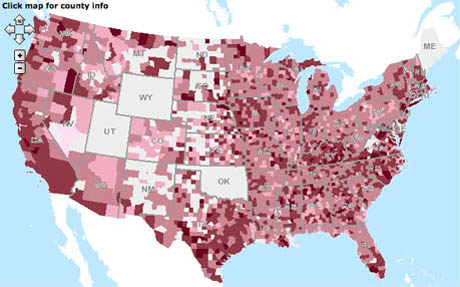
In many ways we are actually what we eat and this article over at the blog for planetizen highlights some specific areas using GIS data that tell us a lot about ourselves as a country.
For thoes who don't know what Planetizen is, it is a:
public-interest information exchange provided by Urban Insight for the urban planning, design, and development community.

It has listings of jobs as well as books graduate schools and really lots of other very interesting and useful links and ideas for people in the planning field, especially people my age in undergraduate programs.

The blog entry I am highlighting was a quick mention of a new resource from the USDA, the Farm to school network, CDC, and the University of Illinois, Chicago(which has a good planning grad program actually) (among others). I was looking through the online Atlas, which gives an online visual representation to the data that was compiled by the group for this resource. It involves obesity percents by country, farmers markets, distance to food markets, restaurant expenditures, junk food taxes, percentage of fast food restaurants; big box stores and a whole lot more.

This data will be extremely interesting in raw form and put into a GIS database and manipulated to see more trends then the basic ones provided on the viewer. I was very excited to see this and I cant wait to have the time to take a look at the data and do some work normalizing data to population or land area to find some truly significant trends, as the article from ediblegeography (highlighted by planetizen) talks about looking at just diabetes rates, you can clearly see the significant proportion of the population in the south and south eastern US suffer from this health issue. Compare that to the %weight of fruits and vegetables eaten and you see that in this category the south does not consume as much as the west, east and west coast, is this a significant trend? I personally think so but you can look at the data and decide for yourself.

From planetizen via ediblegeography